- Hand Reading Mini-Course -
DISEASES - Phantom pictures, trisomies, fingerprints, loops, arches & whorls
INDEX (P1) - INTRO (P2) - HISTORY (P3-7) - DISEASES - (P8-13) - PSYCHIATRY (P14-25) - PSYCHOLOGY (P26-32) - CONCLUSION (P33-34)

Hand Diagnostics & Diseases:
phantom pictures, trisomies, fingerprints, loops, arches & whorls!
The very high positioned axial triradius provides an explantion for the fact that in het hands of people with Patau's syndrome (trisomy 13) or Edward's syndrome (trisomie 18), the A-line has frequently a vertical progression towards the wrist: see figure B-2b + table B-1. The other trisomies are usually featured with a horizontal progression of the A-line: see figure B-2c. For in these syndromes the axial triradius is usually positioned a bit lower compared to Patau's syndrome (trisomy 13) and Edward's syndrome (trisomy 18): see figure B-1.
On the basis of a dermatoglyphic analysis of the fingerprints, the various syndromes mentioned can be discriminated from each other very well: see table B-1.
From the 'phantom picture' related to Down's syndrome (see: figure A-7 on page 5) one can observe that Down's sydnrome is frequently featured with ulnar loops on all finger (possibly combined with a radial loop on the ringfinger.
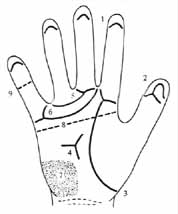
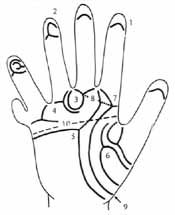
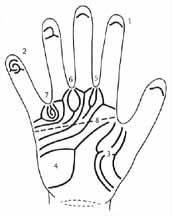
Figuur B-3: 'phantom pictures'1 for the hand: Edward's syndrome (a),
Patau's syndrome (b) and Warkany's syndrome (c).
Edward's syndrome is usually featured with arch fingerprint patterns on all 10 fingers (possibly combined with a radial loop on the thumb): see figure B-3a (in the hands of normal people a radial loop on the thumb is very rare).
Patau's syndrome is featured by a large number of arch patterns combined with radial loops on the ringfinger and the little finger: see figure B-3b (in the hands of normal people this is a very rare combination).
Warkany's syndrome is frequently featured with arches combined with whorls: see figure B-3c (in the hands of normal people the combination of arches and whorls is usually observed in less than 10%.
Sources:
1 - Schaumann, B. & Alter, M. Dermatoglyphics in Medical Disorders. Springer-Verlag, New York., 1976.
A brand new masterclass in scientific hand reading is also available here:
Decoding The Language of The Hand:
how to find 36 conditions with just 54 major hand signs!
Common used synonyms for hand reading are: palmistry - palm reading - hand analysis - chirology - chiromancy - chirognomy