- Hand Reading Mini-Course -
PSYCHIATRY - Schizophrenia: nails, finger length, thumb, index finger, ring finger & little finger
INDEX (P1) - INTRO (P2) - HISTORY (P3-7) - DISEASES - (P8-13) - PSYCHIATRY (P14-25) - PSYCHOLOGY (P26-32) - CONCLUSION (P33-34)

Hand Diagnostics & Psychiatry:
schizophrenia: nails, finger length, thumb, index finger, ring finger & little finger
Another interesting parallel between the hands of schizophrenics and the hands of mentally disabled people concerns the nails. The research of Charlotte Wolff has shown that the hands of both schizophrenics (42%) and mentally disabled people (43%) show a relative high percentage of spatula-shaped nails - compared to the hands of 'normal' people (22%): see figure C-4. Defective developed nails are frequently observed in the hands of both schizophrenics (19%) and mentally disabled people (26%) as well - compared to 'normal' people (0%).
Wolff's research program1 has also indicated that the hands of schizophrenics are frequently featured with characteristics which are hardly ever seen in the hands of BOTH 'normal' people and the hands of mentally disabled people. Some of the most important examples are related to finger length:
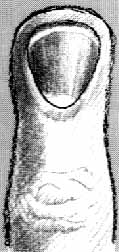
Figure C-4: a spatula-shaped nail.
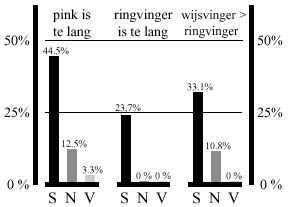
Figure C-5: schizophrenic hand features.
1 - the little finger is too long.
2 - the length of the ring finger equals the length of the middle finger.
3 - the length of the index finger is longer compared to the length of the ring finger.
- Figure C-5 present the accessory figures for these 3 'schizophrenic' hand features, specified as: the schizophrenics (S), the normal people (N), and the mentally disabled people (V).
An American study on twins (only one subject of each twin suffers on the schizophrenia disease) executed by Bracha2 has indicated that the hands of the schizophrenic twin-subjects are frequently featured with: a short thumb, short nail phalanges, and a small thenar (thumb mouse). Table C-4 presents an indication for the predictive reliability of these 3 morphological hand features.
| - Table C-4: the predictive reliability of 3 morphological hand features. |
| - ------ Indicator ------------------------------------ % |
|
-
1----
Short nail phalanges----------------
78.0 % - 2---- Small thenar--------------------------- 71.0 % - 3---- Short thumb--------------------------- 70.0 % |
|
-
% = the number of correction predictions - compared to the number of predictions. |