- Hand Reading Mini-Course -
PSYCHIATRY - Psychosis: dermatoglyphics, fingerprint, AtD angle & axial triradius
INDEX (P1) - INTRO (P2) - HISTORY (P3-7) - DISEASES - (P8-13) - PSYCHIATRY (P14-25) - PSYCHOLOGY (P26-32) - CONCLUSION (P33-34)

Hand Diagnostics & Psychiatry:
psychosis - dermatoglyphics, fingerprint, AtD angle & axial triradius!
What is a PSYCHOSIS?
A 'psychosis' or a 'psychotic' state of mind is: a sever psychological state of mind where the subject is not able discriminate the outside (objective) reality from the inside (subjective) reality1. Possible aspects of psychotic behavior are: delussions, hallucinations and thinking disorders. Genes may play a part in the onset of this kind of behavior. Table C-1 (see page 14) describes the various psychoses which are described in the DSM-IV system of classification.
The relationship between hand features and psychoses (other than schizophrenia) has been studied in a relative small number of studies. Nevertheless, these studies have produced results which appear to be related to schizophrenia.
LEVEL 1: the dermatoglyphics and psychotic behavior.
In a study executed by Hilbun2 the hands of 20 psychotic children had e.g. a relatively high number of fingerprint whorls. In a study executed by Markow & Gottesmann3 the hands of twins had frequently a different pattern on individual fingers of both hands.
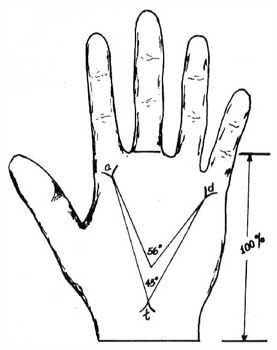
The study of Hilbun2 describes a high frequency of a palmar loop between the middle finger and the ring finger. The axial triradius was more frequently observed in the lower parts of the palm, however the AtD-angle showed frequently a value above 56 degrees, see: table C-7 and figure C-8.
Table C-7: the AtD-angle in psychotic people.
| - AtD-angle | - Normal | - Psychotic |
| - t - less than 450 | - 63 % | - 25 % |
| - t' - between 450 and 560 | - 21 % | - 10 % |
| - t'' - more than 560 | - 2 % | - 50 % |
| - tt' (= 2 triradii) | - 6 % | - 10 % |
| - Overige combinaties | - 8 % | - 5 % |