|
|
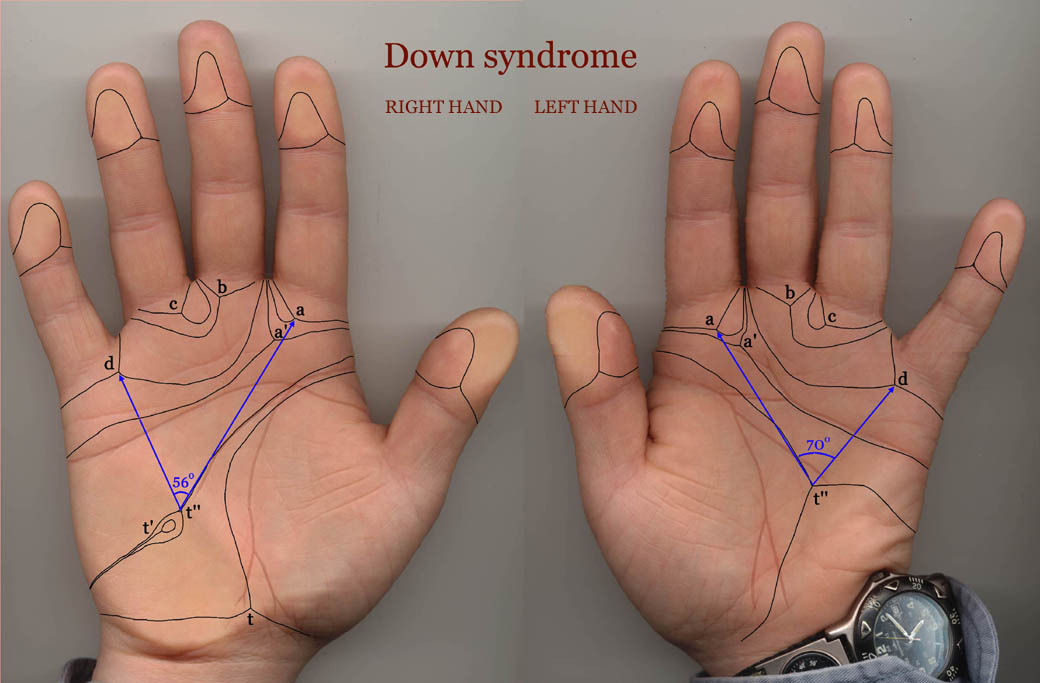
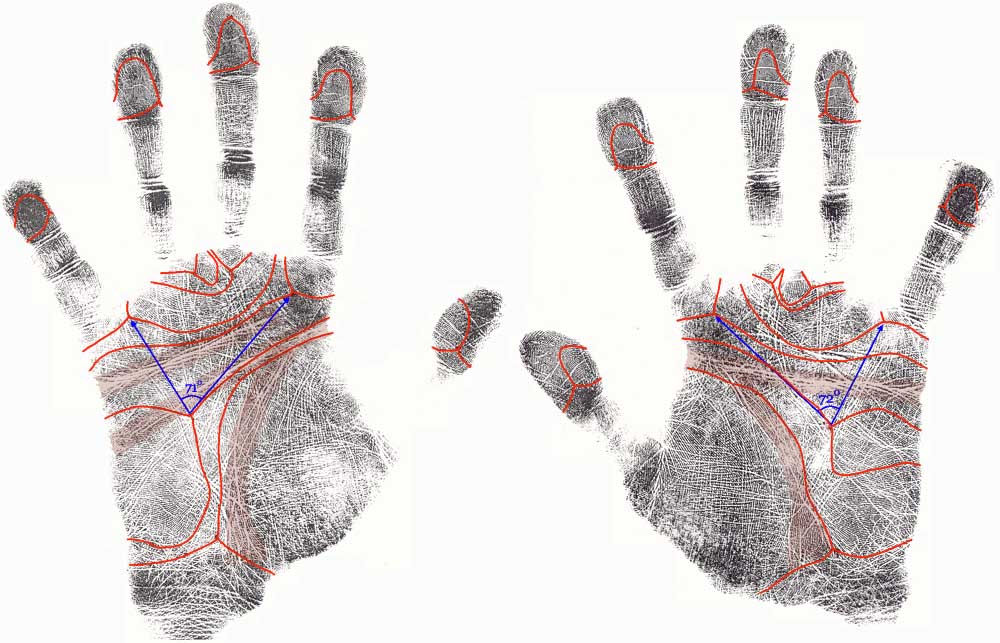
- HAND CASE STUDIES IN DOWN SYNDROME -
 HAND SIGNS & HAND DIAGNOSTICS:
• Hand signs in DOWN SYNDROME!
_- Down syndrome case study 1
_- Down syndrome case study 2
• Hand signs in FRAGILE-X SYNDROME!
_- Fragile-X syndrome case study 1
_- Fragile-X syndrome case study 2
_(In people with autism 2% to 6% have Fragile-X syndrome!)
• Hand signs in DIABETES MELLITUS!
• Hand signs in RHEUMATOID ARTHRITIS!
• Hand signs in PSORIASIS!
• Hand signs in SCHIZOPHRENIA!
HAND TEST:
• MARFAN SYNDROME hand test!
BIG FIVE PERSONALITY DIMENSIONS:
• Hand constellations in Agreeableness!
• Hand constellations in Conscientiousness!
• Hand constellations in Extraversion!
• Hand constellations in Neuroticism!
• Hand constellations in Openness!
SIMIAN LINE INDEX:
INTRO: About the Simian Line (a.k.a. 'simian crease')
• HOW TO RECOGNIZE a 'complete' Simian Line?
• WHY PALM CREASE NAMED the Simian Line?
• BRIEF HISTORY of the Simian Line
• ETHNIC POPULATIONS & the Simian Line
• MEDICAL PROBLEMS & the Simian Line
• PSYCHOLOGY & the Simian Line
• PROJECTS related to the Simian Line
• SYNONYMS for the Simian Line
• FAMOUS Simian Line holders
MORE HAND DIAGNOSTICS:
• Understanding hand shape!
• The hand lines (palmar creases)
• The Sydney line
• Fingerprints (+ dermatoglyphics)
• The Hypothenar whorl
• What can finger length reveal?
• The 5th finger (pinky)
• The fingernail tutor
• The fingernail tutor
• The hand sign tutor: 300+ hand signs! [via 9 hand levels]

MEDICAL HAND ANALYSIS
THE TOP 10 HAND SIGNS FOR
RECOGNIZING DOWN SYNDROME:
(Ranked by 'Log Odds Ratio' = LOR)
I - 5Th finger interphalangeal creases: single crease
[Down syndrome hand sign 9-4: LOR = +4.87]
II - Palmar ridge line A: ends between pinky finger & distal transverse crease (both hands)
[Down syndrome hand sign 8-4: LOR = +4.07]
III - Palmar axial triradius: atd angle 57o or larger
[Down syndrome hand sign 8-10: LOR = +3.96]
IV - Hyper extensible finger joints
[Down syndrome hand sign 2-1: LOR = +3.58]
V - Dysplasia: palmar ridge dissociation [broken skin ridges]
[Down syndrome hand sign 8-15: LOR = +3.18]
VI - Extraordinary short fingers [brachydactyly]
[Down syndrome hand sign 5-1: LOR = +3.11]
VII - Hypothenar [mount of moon]: large ulnar loops
[Down syndrome hand sign 8-14: LOR = +3.02]
VIII - Simian crease (both hands)
[Down syndrome hand sign 9-1: LOR = +2.69]
IX - Fingerprints: radial loop on ringfinger
[Down syndrome hand sign 8-2: LOR = +2.46]
X - Hypothenar [mount of moon]: 3 or more triradii
[Down syndrome hand sign 8-12: LOR = +2.32]
This TOP 10 shows that the palmar dermatoglyphics play a key rol in recognizing Down syndrome (see hand signs II, III, V, VI & IX); 4 of these signs relate to the palmar hypothenar zone [in the field of palmistry a.k.a. the 'mount of Moon'].
NOTICE: Log Odds Ratios are calculated from the prevalence (%) among Down syndrome patients & controls.
Hand signs in Down Syndrome:
case study 2 (male)
Diagnostic-Assessment for DOWN SYNDROME!
[A larger picture is available at the bottom of this page!]
Is DOWN SYNDROME confirmed for case 1 via the 4 requirements for Down syndrome? An analysis of the individual hand signs: 1st major perspective: FUNCTION:• Level 1 - HAND BEHAVIORS in Down syndrome: (No hand signs identified yet) • Level 2 - HAND MOTORICS in Down syndrome: 2-1 - UNKNOWN Hyper extensible finger joints 2-2 - YES Hypotonia (low muscle tone) 2-3 - UNKNOWN Palmomental reflex 2nd major perspective: PROPORTION• Level 3 - HAND SHAPE in Down syndrome: 3-1 - UNKNOWN Small hands (hand length < 10 % of body length) 3-2 - NO High hand index: palm width vs. hand length (ratio > 47 %) • Level 4 - PALM SHAPE in Down syndrome: 4-1 - NO Short palm length vs. palm width (squarish shaped: ratio > 85 %) • Level 5 - FINGER SHAPES in Down syndrome: 5-1 - YES Abnormally short fingers [brachydactyly] 5-2 - NO Thumb: short (low set) position 5-3 - YES Pinky finger: very short 5-4 - NO Incurved pinky finger [clinodactyly] 3rd major perspective: SKIN• Level 6 - SKIN RELATED QUALITIES in Down syndrome: (No hand signs identified yet) • Level 7 - FINGERNAILS in Down syndrome: 7-1 - UNKNOWN Very short fingernails [brachyonychia] 7-2 - UNKNOWN Very small fingernails [micronychia] • Level 8 - DERMATOGLYPHICS in Down syndrome: 8-1 - YES Fingerprints: 10 ulnar loops 8-2 - NO Fingerprints: radial loop ringfinger (+ ulnar loop index finger) 8-3 - NO Fingerprints: radial loop pinky (+ ulnar loop index finger) 8-4 - YES Palmar ridge line A: ends btw. pinky finger & distal transverse crease (both hands) 8-5 - YES Palmar ridge line B: ends btw. pinky & ring finger (both hands) 8-6 - YES Palmar ridge line C: ends btw. ring- & middle finger (both hands) 8-7 - NO Palmar triradius C (left hand): missing or 'abortive 8-8 - NO Palmar ridge line D: radial exit [btw. index finger & thumb] 8-9 - YES Alignment of ridges over the distal palmar area: 'transverse' 8-10 - YES Palmar axial triradius: atd angle 57o or larger 8-11 - YES Palmar axial triradius: distally displaced (t") [(distance btw. axial triradius and the triradius below middle finger is typically smaller than distance between triradius below index finger and triradius below the pinky)] 8-12 - NO Hypothenar [mount of moon]: 3 or more triradii 8-13 - NO Hypothenar [mount of moon]: whorl 8-14 - YES Hypothenar [mount of moon]: large ulnar loops 8-15 - YES Dysplasia: palmar ridge dissociation [broken skin ridges] DERMATOGLYPHIC CONTRA-INDICATOR (ignore if not present): 8C-1 - NO Pattern on thenar [mount of venus] • Level 9 - (MAJOR) LINES in Down syndrome: 9-1 - 1/2 Simian crease (both hands) 9-2 - 1/2 Sydney line (both hands) 9-3 - NO Distal transverse crease (heart line): extended 9-4 - NO 5th finger interphalangeal creases: single crease for the hand in Down syndrome met? -D.S. REQUIREMENT no.1: The person requires to have significant hand signs for Down syndrome in 4 of the 5 major perspectives of the hand, including: proportion, skin, palm & fingers YES - D.S. REQUIREMENT no.2: The person requires to have at least 5 of the 15 hand signs that relate to the dermatoglyphics (= level 8) YES - D.S. REQUIREMENT no.3: The person requires to have at least 1 of the 7 possible hand signs that relate directly to the pinky finger YES - D.S. REQUIREMENT no.4: The person requires to have at least 8 out of the 32 listed hand signs YES The hands of this person (who has Down syndrome) meet all 4 requirements for the hand in Down syndrome. He also has 6 of the TOP 10 hand signs for Down syndrome, and his 13 significant hand signs for Down syndrome are found in 4 out of 9 levels of the hand. Therefore the hand markers in this person firmly confirm his diagnosis: Down syndrome! Another case study is available here: Down syndrome: case 1 |


|
© COPYRIGHT 2002-2017: |