Giving: hand research


HAND RESEARCH : HAND DIAGNOSTICS


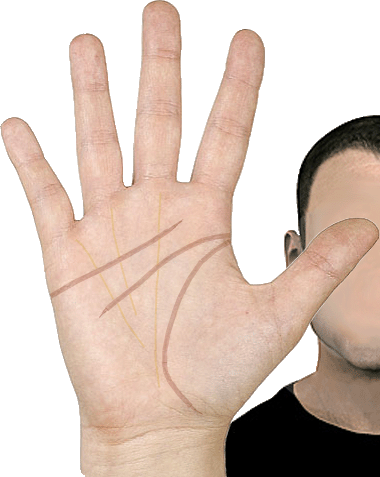
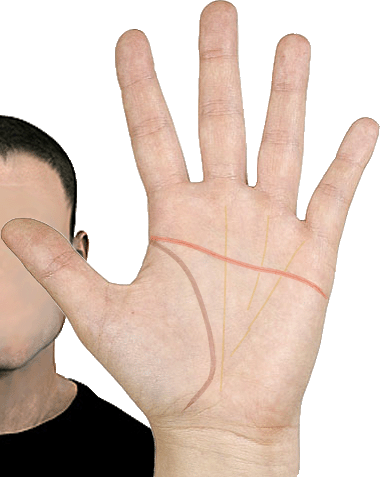
The major hand lines.The simian line: a single palmar crease.

- NORMAL HAND LINES - vs. - THE SIMIAN LINE -
SIMIAN LINE INDEX:

INTRO: About the Simian Line (a.k.a. 'simian crease')

HOW TO RECOGNIZE a 'complete' Simian Line?
WHY PALM CREASE NAMED the Simian Line?
BRIEF HISTORY of the Simian Line
ETHNIC POPULATIONS & the Simian Line
MEDICAL PROBLEMS & the Simian Line
PSYCHOLOGY & the Simian Line
PROJECTS related to the Simian Line
SYNONYMS for the Simian Line
FAMOUS Simian Line holders

SIMIAN LINE & DIAGNOSTICS:
The Simian Line in DOWN SYNDROME!
The Simian Line in FRAGILE X SYNDROME!
_(In autism 2% to 6% have Fragile X syndrome!)

Video: freaky facts about the simian line


MORE HAND DIAGNOSTICS:

The hand lines (palmar creases)
The Sydney line
The Hypothenar whorl
The 5th finger (pinky)
The fingernail tutor

More news - hands on health care!

EARLY HAND DIAGNOSTICS:
& HANDS ON HEALTH CARE!!


- THE SIMIAN LINE -

ABOUT THE USE OF THE FAMOUS 'SINGLE PALMAR CREASE' AS A NOTORIOUS MARKER IN HAND DIAGNOSTICS


Medical problems & the Simian Line

The simian line became famous for it's significance in Down's syndrome, but in time hundreds of academic scientifc publications have linked simian lines with a 'rainbow' of syndromes, diseases and other medical problems.

WrongDiagnosis presents a list of 123 causes that appear to be linked with the simian line.

Quite a few syndromes have been linked with the simian line. The table below presents percentages for the occurence of the simian line in relatively common syndromes (including patients & controls from various countries):

Syndrome:

Country

Patients

Controls


Down syndrome [trisomie 21]


China


41.5 %


9.9 %

-- (occurence: 1 in 1,000 births)

Germany

31.5 %

1.5 %

Italy

53.3 %

1.0 %

Japan

48.0 %

9.8 %

North-America

M: 42.1 %
F: 31.6 %

M: 6.5 %
F: 4.5 %

Sweden

28.8 %

1.6 %


• Edwards syndrome [trisomie 18]


(various countries)


77.2 %


5.5 %

-- (occurence: 1 in 3,000 births)

(various countries)

75.5 %

-


Fragile X syndrome [Xq27]


Germany


13.3 %


3.0 %

-- (occurence: 1 in 4,000 births;
-- 1 in 250 females & 800 males are
-- carriers of Fragile X premutation)

Central Europe

M: 22.0 %
F: 14.3 %

M: 1.0 %
F: 1.0 %

Italy

25.0 %

4.2 %


• Klinefelter syndrome [XXY]


(various countries)


M: 12.0 %


5.5 %

-- (occurence: 1 in 600 male births)

(various countries)

M: 11.8 %

-


• Marfan syndrome


(various countries)


M: 22.3 %
F: 13.2 %


M: 9.7 %
F: 6.2 %

-- (occurence: 1 in 5000 births)


• Turner syndrome [45, X0]


(various countries)


F: 27.7 %


5.5 %

-- (occurence: 1 in 2,000 female births)

(various countries)

F: 27.7 %

-


NOTICE: Quite some of the data above is summarized in:
- Hautleistenfibel, A. Rodewald (1981)
- Dermatoglyphics in Medical Disorders, Schaumann & Alter (1976)


Other more rare syndromes that are linked with the simian line are e.g.:

• Aarskog-Scott syndrome;
• cat-cry syndrome (cri-du-chat) [5p-] - 82.2 %;
• Cohen syndrome;
• Cornelia de Lange syndrome - 65.2 %;
• fetal alcohol syndrome;
• Kabuki syndrome - 18 %;
• Noonan syndrome;
• Patau syndrome [trisomy 13] - 59.5 %;
• Poland syndrome;
• Rubella syndrome;
• Rubinstein-Taybi syndrome - 39.0 %;
• Seckel syndrome;
• Smith-Lemli-Opitz syndrome - 78.4 %;
• Warkany syndrome [trisomy 8] - 37.5 %, 47.1 %;
• Williams-Beuren syndrome;
• Wolf-Hirschhorn syndrome - 52.3 %;
• Zellweger syndrome;
• 18p-, 18q- and 18r syndrome - 14.3 %, 44.8 %, 13.0 %.

Beyond these syndromes (which are usally caused by- or featured with genetic aberations), the simian line has also been related to various (non-)genetic diseases such as: diabetes mellitus (type 1 & 2), familial deafness, and leprosy.

But this doesn't implicate that the simian line can be associated with any diseases. For example, auto-immune diseases (which typically have a higher occurence in females than in males) are generally not associated with a higher occurence of the simian line (which is more common in males). Though diabetes mellitus type 1 could be the exception that confirms the rule!

Simian crease. Single transverse crease. Single palmar transverse crease.


What is in 2010 the state of knowledge about how simian lines relate to human psychology, including personality & character? ...more.

Counter