- Hand Reading Mini-Course (P5) -
HISTORY - Down syndrome: the simian crease, dermatoglyphics & palmar creases
INDEX (P1) - INTRO (P2) - HISTORY (P3-7) - DISEASES - (P8-13) - PSYCHIATRY (P14-25) - PSYCHOLOGY (P26-32) - CONCLUSION (P33-34)

Hand Diagnostics & the History:
Down syndrome - the simian crease, dermatoglyphics & palmar creases!
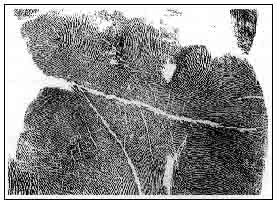
Figure A-4: example of a simian crease.
The simian crease is recognized as a horizontal crease which covers the complete width of the palm. Both in handanalysis and in science this crease is usually considered as a merging of the heart line and the head line1. The term simian crease' is named to the fact that the hands of monkey-like (simians) usually shows 3 or 4 horizontal creases, which appear to be related to the human simian crease.
The discovery made by R.L. Down is related to the fact that the human simian crease is observed in the hands of only 1% to 5% of white people. However, the simian crease is very frequently observed in the hands of people who have Down's syndrome. Research programs show results varying from 31% to 86%.1 One should notice that the simian crease is more frequently observed in some other (non-white) populations. About 10% of the asian population has a simian crease, and studies in the hands of African pygmies have shown percentages close to 30%.2
In the beginning of the 20th century biologists and anthropologists got excited to study the dermatoglyphics and the palmar creases. And nowadays the dermatoglyphics are known as the most important aspect of the human body to study genetic and biological differences among different populations.
The following will show that next to Down's syndrome the simian crease is very frequently seen in other (genetic) disorders. And the section NEUROTICISM presents new research results linking the simian line to the human psychology of 'healthy' people.
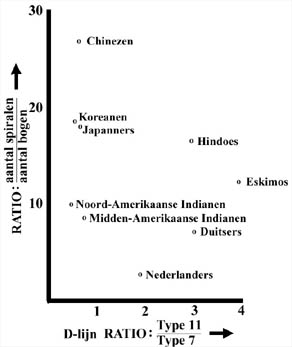
Figuur A-5: dermatoglyphic features in populations.3
References:
1 - Schaumann, B.A. & Kimura, S. (1991). Palmar, plantar, and digital flexion creases: Morphologic and clinical considerations. Birth Defects: Original Article Series, vol.27, no.2, p.229-252.
2 - Lestrange, M.T. de (1960). The transverse crease in Europe: Index and comparative study of different samples cited in the literature. American Journal of Phys. Anthropology, 35, p.2005-232..
3 - Cummins, H & Midlo, C. Finger prints, palms and soles: an introduction to dermatoglyphics. Philadelphia: Blackistion Co., 1943.
A brand new masterclass in scientific hand reading is also available here:
Decoding The Language of The Hand:
how to find 36 conditions with just 54 major hand signs!
Common used synonyms for hand reading are: palmistry - palm reading - hand analysis - chirology - chiromancy - chirognomy