
Palmistry's digital analogue: the new Chiromancy?
- Could the English Professor of Psychology John T. Manning be identified as the high priest of the new Chiromancy? -

The famous Irish palmist Cheiro is known as the 'godfather' of the classic Chiromancy, could the English Professor of Psychology John T. Manning be identified as the high priest of the new Chiromancy?
Author: Chris McManus - professor of psychology and medical education at University College London.

Chris McManus - author of the book: 'Right Hand, Left Hand
THE NEW CHIROMANCY
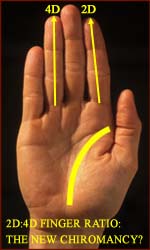
To understand the new Chiromancy, hold up your right hand, palm towards you and fingers together, and compare the lengths of the second (index) and fourth (ring) fingers. Better still, use a ruler, measuring each finger from the tip to the crease where it joins the palm. Dividing the length of the second digit by the length of the fourth digit gives what in the jargon is known as the 2D:4D ratio. Men generally have longer ring fingers, and thus a lower 2D:4D ratio.
FINGER LENGTH & SEXUAL DIMORPHISM
Although Manning likes to describe that difference as a "sexual dimorphism" - two distinct forms that differentiate the sexes, in a similar way to beards, breasts and baldness - there is a large overlap between the sexes, such that the sex difference is found reliably and consistently only when studying a hundred or more men and women. The overlap is both the strength and the weakness of 2D:4D, for it means that some men have a more feminine pattern and some women have a more masculine pattern.
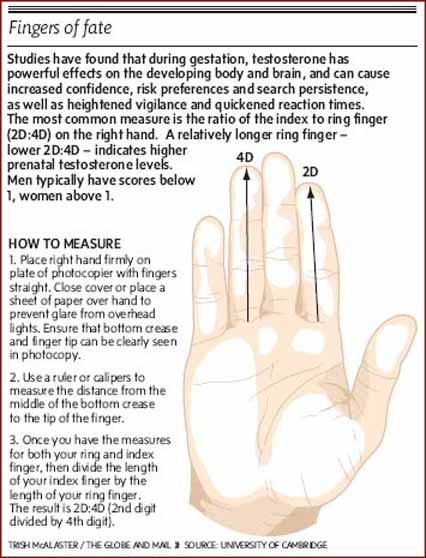
FINGERS OF FATE
The simplicity of the measure has inevitably launched a thousand research papers on hundreds of topics, finding correlations of 2D:4D with - to select just the terms used in Manning's chapter titles - heart attacks, breast cancer, infectious diseases, skin colour, running speed, football ability, sexual attraction, homosexuality, and schizophrenia.
Just as the motto of the News of the World used to be "all human life is there", where "all" was used in the peculiarly technical sense of referring entirely to sex, so the 2D:4D ratio seems to encompass all human life, but with sex, sexual development and sexual selection always nearby.
Central to Manning's theory is the belief that there is an underlying connection between finger lengths and sexual development, mediated via the sex hormone testosterone, so that whenever one sees a longer ring finger one can infer the existence of higher testosterone levels early in foetal development.
Folk mythology has long suggested that men with large hands or feet will be well endowed, but there seems to be biological truth in that adage, with biologists finding that the same gene family, the Hox genes, underpins the development of "apical appendages" (fingers and penises in other words).
Illustration presented by:
University of Cambridge.
THE 2D:4D FINGER RATIO SCIENCE - A CRITICAL REVIEW
Nevertheless, there is a problem here. Just because differences overall between men and women can be explained in terms of foetal testosterone, that does not also mean that differences between one man and another man, or one woman and another woman, are also due to differential exposure to foetal testosterone. After all, it is because men have a Y chromosome and hence have higher testosterone levels than women that men on average are also taller than women.
However, that doesn't mean that tall men are taller than shorter men because they had more foetal testosterone, but rather height differences between men mainly result from myriad polygenic and environmental factors unrelated to testosterone and the Y chromosome. Here surely is the greatest weakness at the heart of the science of 2D:4D. Something is being measured that undoubtedly differs both between and within the sexes, but whether it is really a surrogate for foetal testosterone levels seems never to have been confirmed, for instance by measuring testosterone levels in amniotic fluid.
Manning's theory generates a strong sense of deja vu, for so much is reminiscent of the rambling, sprawling, all-encompassing theory of almost all things neuropsychological, and indeed much beyond, put forward in the late 1980s by Norman Geschwind and Albert Galaburda, at whose core were variations in foetal testosterone. Once again, explanation often seems to run far ahead of both proper theorising and careful data gathering, as opposed to arm waving.
|
|