
The Simian Line & it's potential implications!
- INTRO (1/14): About the single palmar transverse crease & the impact of a (harmless) minor physical anomaly -
According medical science the 'single palmar transverse crease' - a.k.a. simian line - is basically recognized to represent an inborn (harmless) minor physical anomaly, which typically starts developing during the 3rd month of pregnancy. What are the potential implications?
Simian lines have a higher prevalence among asians, but a simian line in both hands is usually seen in not much more than 1% among caucasians. Hand reading experts claim that a simian line bares significance for the personality in an individual; however, is this a valid claim?
This article presents a summary of the core aspects and most common issues involved with simian lines. This article presents a summary of the core aspects and most common issues involved with simian lines.
Let's take a look at how a simian line can be recognized properly, and what are the implications of a (harmless) minor physical anomaly?
 SIMIAN LINE INDEX (14 sub-sections):
INTRO: The simian line: a minor physical anomaly!
• HOW TO RECOGNIZE Simian Lines?
• WHY THE NAME Simian Line?
• HISTORY of the Simian Line
• ETHNICITY & the Simian Line
• HEALTH & the Simian Line
• PSYCHOLOGY & BEHAVIOR: the Simian Line
• BIG FIVE PROFILING: personality & Simian Line
• PSYCHODYNAMIC PROFILES: the Simian Line
• HAND SIGN TUTOR: Simian Line - quick summary
• FAMOUS PEOPLE with Simian Lines [80+ celebs]
• PROJECTS related to the Simian Line
• ONLINE READINGS for the Simian Line
• SYNONYMS for the Simian Line
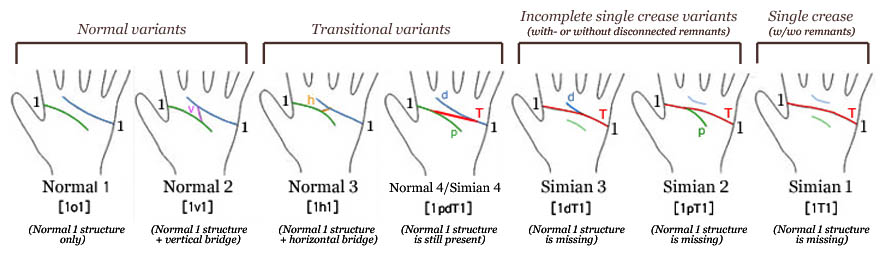
The human hand usually shows two major transverse creases (which are still present in transitional variants).
However, in a 'complete simian line' there is only a single crease present, leaving the impression that something appears to be missing!

How to recognize simian lines?
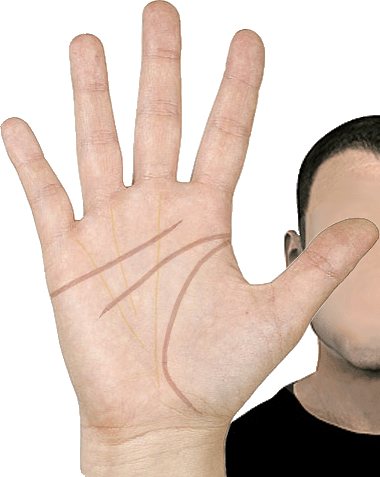
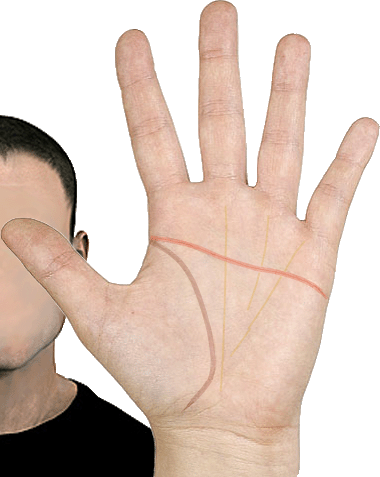
The concept of the classic simian line can be recognized to represent a 'complete' fusion between the two horizontal palmar creases (heart line & head line), leaving the presence of a single line that is featured with the impression that something appears to be missing (see the right picture below leaving the impression of a single line).
More details in the section:
How to recognize simian lines?
Why the name 'simian line'?
The name 'simian line' origins from the fact that the term 'simian' is a synonym for 'primate'; in the hands of primates it is normal to see a single crease (or multiple creases) transversing the full palm'.
Today, researchers & experts in science often prefer to use other names to describe simian lines, merely because of the 'primate' connotation.
More details in the section:
Why the name Simian Line?
History of the simian line!
In 1877 Pierre Paul Broca (a French physician, anatomist and anthropologist) introduced the ethnic aspect of palmar creases in anthropology. Back then he already pointed out that simian lines occurs in about 1-2% of Europeans, while it can be observed in more than 10% of some Asian populations.
A few decades later, in 1906 R.L. Down described the medical significance of the simian line as a diagnostic marker. His report described the relationship between the simian crease and Down's syndrome. But it took many years before the signifance of his observations were generally recognized in medical science, for until 1959 (when J. Lejeune discovered that the syndrome results from an extra chromosome: trisomy 21) Down's syndrome was not yet recognized as a unique disorder.
Much later, e.g. Kimura (1991) found in prenatal studies based on the hand developement in embryos that the simian line typically starts developing not before the second half of the 3rd month of pregnancy; though it might then still take a few more months before a full simian crease is formed.
More details in the section:
History of the simian line!
Ethnicity & the simian line!
The prevalence of simian lines varies significantly around the world due to a genetic factor that is associated with ethnicity. Among ethnic populations the highest prevalence is found in African Efé pygmies (a population that belongs to the smallest groups of people in the world).
Interestingly, there are also many other types of genetics involved with simian lines. For example, a comparison between males and females around the world shows that males typically have a 50% higher prevalence of simian lines (compared to females).
More details in the section:
Ethnicity & the simian line!
Health & the simian lines!
Beyond ethnicty and sexe, other genetic factors can become involved with the development of a simian line (during prenatal development). During the 20th century the simian line became linked with a 'rainbow' of syndromes, diseases & other medial problems.
A quick summary of the effects seen in major diagnostic themes:
• Simian line is 20x more common in Edwards syndrome
• Simian line is 15x more common in Patau syndrome
• Simian line is 10x more common in Down syndrome
• Simian line is 5x more common in Fragile-x syndrome
• Simian line is 3x more common in Diabetes Mellitus
• Simian line is 3x more common in Schizophrenia
• Simian line is 2x more common in low cognitive efficiency
• Simian line is 2x more common in Neuroticism high scorers
• Simian line is 2x more common in Marfan syndrome
• Simian line is 2x more common in Psoriasis
• Simian line is 2x more common in Rheumatoid Arthritis
NOTE: All numbers above are based on prevalence statistics relative to control populations, which are supposed to be representative for the general population.
The simian line is known to have the highest prevalence in the so-called 'trisomy syndromes', which represent a group of genetic disorders featured with an extra chromosome - this creates a so-called 'trisomy' in one of the 23 chromosome pairs. The two most common trisomy syndromes represent in respective:
- Down syndrome (trisomy 21), where the prevalence of the simian line is usually reported to be around 40%;
- Edwards syndrome (trisomy 18), where the prevalence has been confirmed to be around 70% - which is higher than in any known human (sub-)population around the world.
Interestingly, in both Down syndrome and Edwards syndrome the simian line is often featured with another (more rare) form of 'fusion' between lines - which manifests through the formation of a 'single interphalangeal crease' in the 5th digit (pinky finger): see picture below.
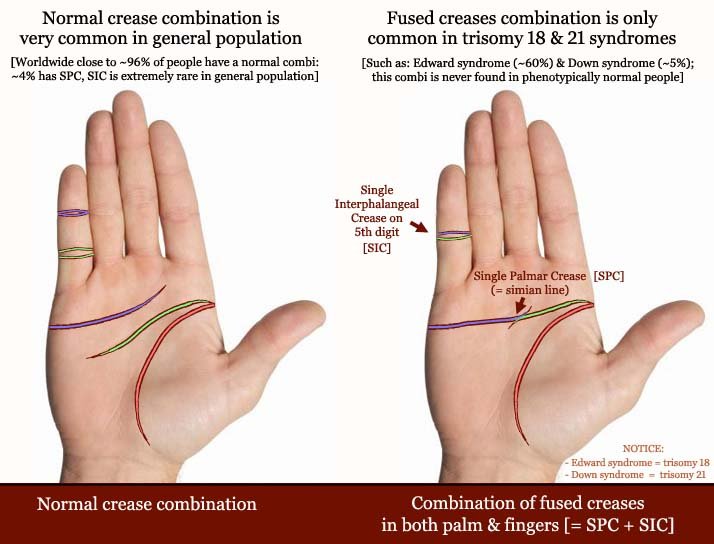
NOTICE: The combination of simian line + single crease on 5th finger is occasionally also present in:
trisomy 13, partial trisomy 9p & Cornelia de Lange syndrome.
Simian line percentages close to 50% have also been reported in more rare variants of trisomy syndromes, such as: trisomy 8 (Warkany syndrome) and trisomy 13 (Patau syndrome).
Resuming, beyond the extraordinary high prevalence among trisomy syndromes, a high prevalence of simian lines has also been reported for a wide spectrum of diseases and disorders. This explains why in the perspective of medical sience the simian line became recognized to represent a minor physical anomaly (MPA). However, by principle, all MPAs can be found more of less found in healthy individuals - for this reason MPA's represent minor congenital physical abnormalities that are typically painless and in themselves harmless. And the impact of an individual MPA - such as the simian line - varies per individual, because it depends on whether the individual has other MPAs!
NOTE: Individual MPA's are known to have no specific diagnostic value. However, in combination with certain other body signs (e.g. other MPAs) they can become significant for a specific disorder. For example: the combination of a simian line & single interphalangeal transverse crease (see picture above) can be recognized to represent a strong diagnostic sign for the presence of a trisomy syndrome; however, other hand signs need to be taken in consideration in order to make an accurate diagnosis. For example, the dermatoglyphics of the hand have been recognized to serve this purpose: to finish the process of diagnosis in this perspective, in order to find the one and only trisomy syndrome for the person involved. Phantom pictures for the hand in trisomy syndromes are presented inside the Down syndrome section + inside the mini-course section 'diseases'.
More details in the section:
Health & the simian lines!
Psychology, behavior & the simian line!
Beyond ethnicity & health issues, the simian line also appears to correlate with various types of behavior. The results reported in studies suggest that the simian line has positive correlations with various severe psychological problems, such as: deliquent behavior, hyperactivity & schizophrenia; however, there are also results which suggest a positive correlation with especially the Big Five dimensions neuroticism (= low emotional stability) & introversion (= low extraversion).
Also, hand reading experts have presented claims involving a correlation between the simian line with a wide range of psychological qualities (thought it appears that those claims have not passed beyond anecdotal stories, which have not been validated with proper research).
Many more details in these sections:
• Psychology, behavior & the Simian Line
• Big Five profiling: personality & Simian Line
• Psychodynamic profiles: the Simian Line
• Hand Sign Tutor: Simian Line - quick summary
Famous people with simian lines!
Even though the simian line is relatively rare among celebrities & famous people, some of them do have the single palmar transverse crease. A collection of 80+ simian line celebrity reports is available, but only 15 of these reports involve a person who has a simian line in both hands!
The top 5 most well-known celebrities with a simian line in both hands are:
• Tony Blair (former UK Prime Minister)
• Takashi Murakami (Japanese artist)
• Ferdinand Marcos (former President of Philippines)
• Salman bin Abdulaziz Al Saud (King of Saudi Arabia)
• Rainn Wilson (American actor, Emmy Award nominee)
For 25 simian line celebrity cases photo impressions involving both hands are available!
More details in the section:
Famous people with simian lines!
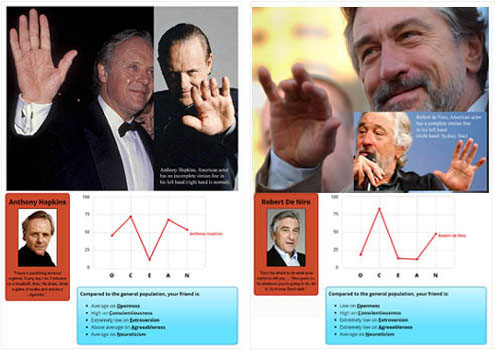
Simian line actors Anthony Hopkins & Robert De Niro have a simian line in just one of their hands. They are not only Oscar winners, they also belong to a very small group of 5 top-actors that have received the "Cecil B. DeMille Award" - the Golden Globe oeuvre award for "outstanding contributions to the world of entertainment" - during the time-span of 2006-2013 (Anthony Hopkins in 2006, Robert De Niro in 2011, and Jodie Foster in 2013). Other Oscar nominees with a single simian line are: Benedict Cumberbatch & Joaquin Phoenix.
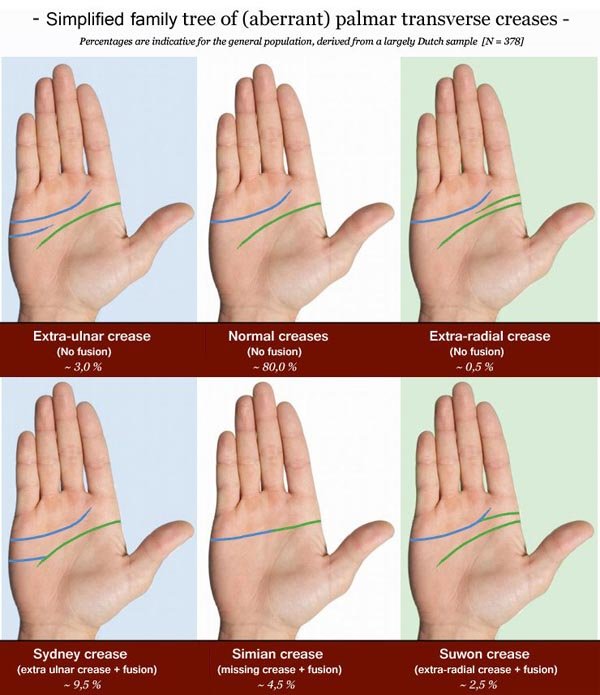
A complete fusion between the heart- and head line is only seen in the concept of the simian line; this unique characteristic is missing in the concept of in respective the Sydney line, extended heart line, and Suwon crease (in the latter is a 2nd head line required to create a fusion between only the upper head line & the heart line).
3 More simian line sections:
• Projects related to the Simian Line
• Online readings for the Simian Line
• Synonyms for the Simian Line
For a better understanding of the unusual characteristics of the simian line, one can use the section 'hand lines (palmar creases)' - which includes the introduction of the innovative 'PIC-model' (which should serve as a helpful 'tool' to classify the COMBINATION of the core characteristics in the three major hand lines!).
The 'PIC model' demonstrates that basically there are up to twelve types of simian lines - most of them are quite rare, but three of the simian related 'PIC types' (see the pictures below) are relatively common: each of these PIC variants can be noticed in more than 1% of the population!!
Read more about the 'complete'- and 'incomplete' simian line variants in: 'How to recognize a simian line?'
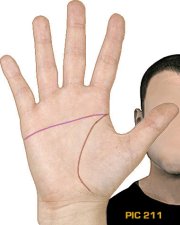
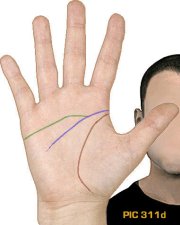
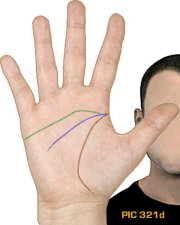
The three most common simian line variants:
PIC type 211 (complete), PIC type 311d (incomplete), and PIC type 321d (incomplete).
[More details available in the section: 'What can hand lines reveal?']
The next simian line section:
• How to recognize Simian Lines?
- Next major section -
Sydney line research!